

Canon in D Piano Sheet Music PDF: A Comprehensive Guide
Canon in D sheet music PDFs are immensely popular, offering musicians access to this timeless piece. Discover resources for free and paid options, alongside arrangement types.
Understanding the Popularity of Pachelbel’s Canon
Pachelbel’s Canon in D enjoys enduring popularity, transcending musical boundaries and captivating audiences for centuries. Its appeal lies in its simple yet profoundly beautiful harmonic progression, a repeating sequence that creates a sense of peace and tranquility. This inherent emotional resonance makes it a favorite for weddings, film soundtracks, and countless other settings.
The piece’s accessibility also contributes to its widespread recognition. While sophisticated in its construction, the core melody is easily recognizable and memorable. This allows musicians of varying skill levels to approach and enjoy performing it, driving demand for Canon in D piano sheet music PDFs. The cyclical nature of the canon, with its interwoven melodic lines, provides a satisfying musical experience for both performer and listener.
Furthermore, the Canon’s adaptability to different instruments and arrangements enhances its lasting appeal. From orchestral versions to solo piano interpretations, the core structure remains intact, allowing for creative exploration and personalization. This versatility ensures its continued relevance in contemporary music and culture.
Historical Context of the Canon in D
Johann Pachelbel’s Canon in D originated around 1680, during the Baroque period. Initially titled “Canon for Three Violins and Basso,” it was part of a larger set of 24 variations on a theme. Interestingly, the Canon remained relatively obscure for centuries, largely unknown outside of a small circle of musicians.
Its rediscovery and surge in popularity didn’t occur until the 20th century, specifically the 1970s. A recording by the Jean-François Paillard Chamber Orchestra propelled it into mainstream consciousness, sparking a wave of interest and numerous arrangements. This newfound fame directly fueled the demand for accessible versions, including Canon in D piano sheet music PDFs.
Prior to its modern revival, the Canon was primarily appreciated for its technical brilliance within musical scholarship. The Baroque era valued intricate counterpoint and harmonic structures, qualities Pachelbel masterfully employed. The piece’s enduring appeal demonstrates a timeless quality that transcends historical context, continuing to inspire musicians and listeners alike.
Why Piano Sheet Music is Sought After
The demand for Canon in D piano sheet music PDFs stems from several factors. Firstly, the piece’s inherent beauty and recognizable melody make it a popular choice for pianists of all levels. It’s frequently requested for performances, weddings, and personal enjoyment.
Secondly, the Canon’s relatively simple harmonic structure, despite its elegant complexity, makes it approachable for beginner to intermediate players. This accessibility encourages learning and provides a rewarding musical experience. The availability of piano sheet music PDFs lowers the barrier to entry, offering convenient and affordable access.
Furthermore, the Canon’s versatility allows for creative interpretation and arrangement. Pianists often enjoy adapting the piece to suit their individual style or ensemble needs. The widespread availability of digital sheet music facilitates easy customization and sharing, contributing to its continued popularity and enduring legacy.

Finding Canon in D Piano Sheet Music PDFs
Locating Canon in D piano sheet music PDFs involves exploring both free and paid options available online. Numerous websites and services cater to musicians’ needs.
Free vs. Paid Sheet Music Options
Choosing between free and paid Canon in D piano sheet music PDFs depends on your needs and priorities. Free options, readily available online, often come with limitations. These may include lower print quality, incomplete arrangements, or potential inaccuracies in the transcription. While suitable for casual players or beginners, they might not suffice for serious study or performance.
Paid sheet music, conversely, generally offers higher quality and accuracy. Professional arrangements are meticulously crafted, ensuring a faithful representation of Pachelbel’s masterpiece. These versions often include detailed fingerings, dynamics, and articulation markings, aiding in a more nuanced and expressive performance. Furthermore, purchasing sheet music supports the composers, arrangers, and publishers who create these resources.
Consider your skill level and intended use. If you’re simply learning the melody, a free version might be adequate. However, for a polished performance or in-depth study, investing in a professionally arranged, paid PDF is highly recommended. Subscription services also provide access to a vast library of sheet music for a recurring fee.
Reputable Websites for Free PDF Downloads
Finding reliable sources for free Canon in D piano sheet music PDFs requires caution. Many websites offer sheet music, but quality and legality vary significantly. IMSLP (International Music Score Library Project) is a highly respected resource, providing public domain scores, though availability of specific arrangements may differ. Be aware that some arrangements on IMSLP may be basic.
MuseScore.com hosts user-submitted arrangements, offering a wide variety of Canon in D versions. However, quality control is less stringent, so previewing the score before downloading is crucial. Look for arrangements with high ratings and positive reviews. Free-scores.com also provides a selection of free sheet music, but again, assess the quality carefully.
Always exercise caution when downloading from unfamiliar websites. Ensure your antivirus software is up-to-date to protect against potential malware. Prioritize sites with clear copyright information and a good reputation within the music community. Remember that downloading copyrighted material without permission is illegal.
Subscription Services Offering Sheet Music
For consistent access to high-quality Canon in D piano sheet music PDFs, subscription services present a compelling alternative to free downloads. Musicnotes.com is a leading platform, offering officially licensed arrangements in various formats and difficulty levels. A subscription unlocks unlimited access to a vast library, including multiple Canon in D versions.
Sheet Music Plus similarly provides a comprehensive catalog with subscription options. They often feature arrangements created by professional musicians, ensuring accuracy and playability. These services typically allow you to print sheet music as needed, offering convenience and flexibility.
Consider Flowkey or Skoove, which combine sheet music with interactive learning tools. While focused on piano lessons, they include Canon in D within their repertoire. These platforms are ideal for beginners or those seeking guided practice. Subscription costs vary, so compare plans to find the best fit for your needs and musical goals.

Types of Sheet Music Arrangements
Canon in D piano sheet music comes in diverse arrangements—beginner, intermediate, and advanced—catering to all skill levels. Choose based on your proficiency and musical goals.
Beginner-Friendly Arrangements
Beginner-friendly Canon in D piano sheet music arrangements simplify the original composition, focusing on easier chord progressions and melodic lines. These versions often feature larger notation, clear fingerings, and minimal ornamentation, making them accessible to those new to piano or with limited musical experience;
Typically, these arrangements will utilize only the core harmonic structure of the piece, avoiding complex inversions or passing chords. The right-hand melody is often presented in a straightforward manner, without extensive embellishments. Left-hand patterns are simplified, frequently employing basic broken chords or single-note bass lines.
Many free PDF resources cater to beginners, offering simplified versions of the Canon in D. Look for arrangements specifically labeled as “easy” or “beginner.” These arrangements prioritize playability over strict adherence to the original, allowing aspiring pianists to enjoy the beauty of Pachelbel’s Canon without being overwhelmed by technical challenges. They are an excellent starting point for building confidence and developing fundamental piano skills.

Intermediate Level Arrangements
Intermediate Canon in D piano sheet music arrangements strike a balance between accessibility and musical depth. These versions retain the core harmonic and melodic structure of the original while introducing more complex elements for developing pianists. Expect to encounter more intricate chord voicings, including inversions and seventh chords, adding richness to the harmonic texture.
The right-hand melody may feature some ornamentation, such as grace notes or trills, requiring greater dexterity and control. Left-hand patterns become more sophisticated, potentially incorporating arpeggios or Alberti bass figures. These arrangements often demand a stronger understanding of music theory and technique.
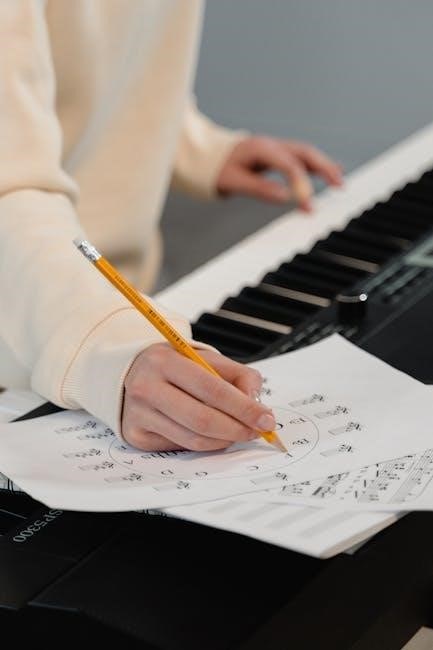
Intermediate sheet music PDFs often include dynamic markings and phrasing suggestions, encouraging expressive playing. While still manageable for dedicated students, these arrangements present a noticeable step up in difficulty from beginner versions. They are ideal for pianists who have a solid foundation and are seeking to expand their skills and musical interpretation of this classic piece.
Advanced Piano Arrangements
Advanced Canon in D piano sheet music PDFs represent the pinnacle of complexity and artistry. These arrangements are designed for highly skilled pianists with a comprehensive understanding of music theory and advanced techniques. Expect substantial alterations to the original, including elaborate embellishments, countermelodies, and harmonic re-interpretations.
Advanced versions frequently feature complex polyrhythms, demanding precise coordination between hands. Chord voicings are often extended and sophisticated, utilizing altered chords and advanced harmonic progressions. The left-hand part may involve intricate arpeggios, octave passages, and independent melodic lines.
These arrangements prioritize expressive interpretation and virtuosic display; They often include detailed dynamic markings, pedaling instructions, and suggestions for rubato. Mastering these PDFs requires significant practice and a deep understanding of the piece’s underlying structure. They are a rewarding challenge for pianists seeking to showcase their technical prowess and musical sensitivity.
Essential Elements of Canon in D Sheet Music
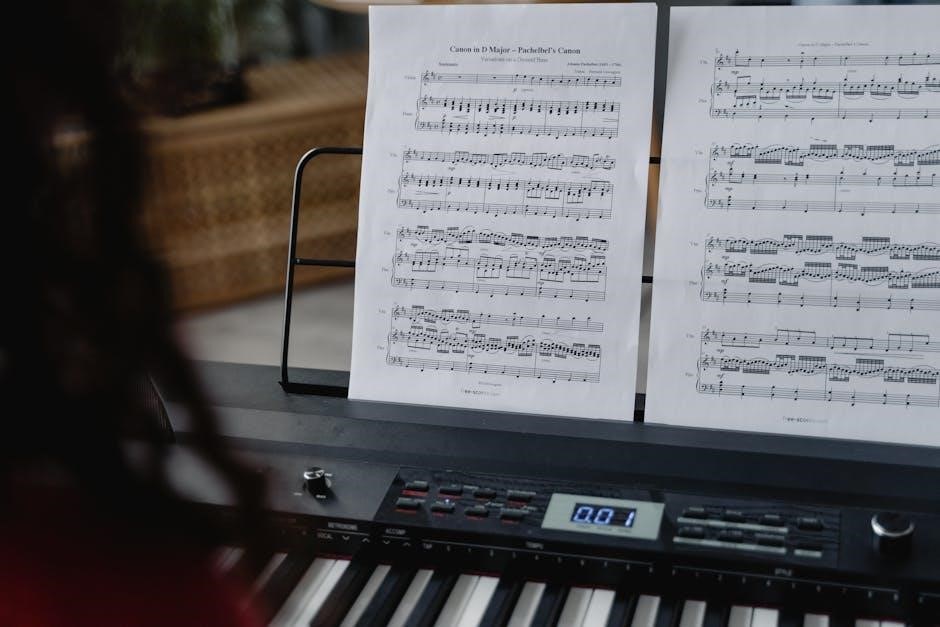
Understanding Canon in D sheet music requires recognizing the key signature, time signature, chord progressions, and melodic patterns for accurate and expressive performance.

Key Signature and Time Signature
Canon in D is fundamentally rooted in the key of D major. This means the sheet music will predominantly feature sharps – specifically, F# and C#. Recognizing these sharps is crucial for accurate reading and playing, as they dictate the tonal color of the piece. The key signature, therefore, will display two sharps on the staff, immediately signaling the harmonic context to the pianist.
Equally important is the time signature, which is consistently 3/4 throughout the Canon. This indicates that each measure contains three quarter note beats. This triple meter contributes significantly to the piece’s flowing, graceful character. Understanding 3/4 time is essential for maintaining the correct rhythm and phrasing.
When examining sheet music, quickly identify the key signature and time signature. This foundational knowledge will streamline the learning process and allow you to focus on the nuances of Pachelbel’s composition. Ignoring these elements can lead to inaccuracies and a less satisfying musical experience.
Understanding Chord Progressions
Canon in D’s harmonic foundation revolves around a repeating chord progression, primarily utilizing the chords of D major, A major, B minor, F# minor, G major, D major, G major, and A major. This sequence, though simple, creates a captivating and emotionally resonant effect. Recognizing this pattern is key to mastering the piece.
Sheet music will often display these chords above the staff, providing a visual guide for pianists. Pay attention to inversions – variations in the order of notes within a chord – as they contribute to smoother voice leading. The consistent return to the D major chord provides a sense of resolution and stability.
Analyzing the chord changes helps internalize the harmonic structure, enabling improvisation and a deeper understanding of the music. Practicing the chord progression separately can solidify your grasp before tackling the full arrangement. This foundational knowledge unlocks a more expressive performance.
Recognizing Melodic Patterns
Canon in D’s beauty lies in its elegant melodic patterns, built upon a repeating bassline and interwoven melodic lines. The sheet music reveals a series of stepwise movements and arpeggiated figures that create a flowing, lyrical quality. Identifying these recurring motifs is crucial for effective learning.
Focus on the initial melodic phrase; it forms the basis for subsequent variations throughout the piece. Notice how the melody is passed between different voices, creating a canon – a musical form where a melody is imitated by one or more parts after a delay.
Sheet music will clearly display these melodic contours. Practice isolating individual melodic lines to understand their shape and phrasing. Recognizing these patterns allows for a more nuanced and expressive interpretation, moving beyond simply playing the notes to truly embodying the music’s spirit.
Printing and Using Your PDF Sheet Music
Canon in D PDF sheet music requires optimal print settings for clarity. Utilize PDF viewing software for editing and practice efficiently with marked-up scores.
Optimal Print Settings for Clarity

To ensure your Canon in D piano sheet music PDF prints with optimal clarity, several settings are crucial. First, select “Fit to Page” or a similar scaling option within your PDF viewer to avoid any cropping of the musical notation.
Choose a high print quality setting – typically 300 DPI or higher – for sharp lines and legible notes; Paper type also matters; heavier weight paper prevents bleed-through if you intend to mark the sheet music.
When printing, disable any options that automatically rotate or adjust the page orientation. A standard portrait orientation is generally best for piano music.
Preview the print before committing to the full document to check for any unexpected issues. Adjust margins if necessary to maximize the usable space on the page without sacrificing readability. Finally, consider printing in grayscale to save ink, as the musical notation doesn’t require color.
Software for Viewing and Editing PDFs
Several software options excel at viewing and, crucially, editing Canon in D piano sheet music PDFs. Adobe Acrobat Reader is a widely used, free option for basic viewing and printing, offering zoom functionality for detailed inspection.
For more advanced features, consider Adobe Acrobat Pro, which allows annotations, highlighting, and even minor edits to the PDF itself. Foxit PDF Reader is a lightweight alternative with similar capabilities.
If you need to transpose the music or make significant alterations, dedicated music notation software like MuseScore or Sibelius can import PDFs (though formatting may require adjustments).
Online PDF editors, such as Smallpdf or iLovePDF, provide convenient browser-based editing tools. Ensure any software you choose supports high-resolution rendering to maintain the clarity of the musical notation when zooming in for practice.
Tips for Practicing with Sheet Music
Effectively utilizing your Canon in D piano sheet music PDF requires a strategic practice approach. Begin by slowly sight-reading the piece, focusing on accuracy over speed. Break down the composition into smaller sections – perhaps four bars at a time – mastering each before connecting them.
Pay close attention to the key signature and time signature, ensuring a solid rhythmic foundation. Use a metronome to develop consistent tempo. Highlight challenging passages or chord changes for focused practice.
Don’t hesitate to annotate your sheet music with fingerings, dynamics, and phrasing markings. Listen to recordings of the Canon to internalize the musicality. Regular, short practice sessions are more effective than infrequent, lengthy ones.
Finally, remember to practice slowly and deliberately, gradually increasing the tempo as your proficiency grows.